


Throughout most of history, the vast majority of people lived in small, agrarian communities, where they lived and died with the same neighbors their entire lives within a relatively small geographic area. In other words, deep, stable, intergenerational relationships were an integral part of life. Connection and community were a given.
In that world, it made perfect sense to gather at a specific time and place, sit in rows, and receive teaching from a (hopefully) educated minister. For most people, it may have been one of the only opportunities available for religious education and formation.
Fast forward to today, and we find ourselves in the exact opposite situation. Through technology, we have access to more content and teaching than anyone could consume in thousands of lifetimes. Yet, we’re starved for connection and community. In the 1950s, advances in transportation and the growth of cities drew more and more people away from farms and into urban areas. Now, the United States is one of the most transient and individualistic societies in human history. The rise of suburbs, which were designed for privacy and separation, only deepened the isolation.
The loneliness epidemic has been well documented for the last few decades. A recent study suggests that up to 21% of Americans are suffering from serious loneliness. In addition to higher rates of depression and suicide, lonely people have a 26% higher risk of dying from high blood pressure and heart disease. Health experts say loneliness is as damaging as smoking 15 cigarettes a day! The prevailing model of church was never designed to address such a crisis of connection.
Designed to Solve the Wrong Problem
Recently, I visited a church near my home. I was greeted at the door with a “good morning,” sat down in a mostly empty pew, tried to sing along with some music, listened to a sermon and some announcements, and then went home. I did not exchange more than 5 words with anyone.
I don’t fault this church. I’m sure they were only doing what they’ve always done. The problem is technology has significantly undercut the value proposition of attending a Sunday service.
The sermon was good, but I’m sure I could have found something better and more relevant within 10 seconds of Google searching. The music was fine, but I also have Apple Music. I could have tuned in to almost any streamed service, anywhere in the world, on YouTube. This church missed the one thing it could have offered that I couldn’t find online: face-to-face, in-person connection.
A few years ago, New Wine Collective conducted a church and spiritual community survey comprised of open-ended questions. We received over 460 responses, which far exceeded our expectations! One question asked, “what would you hope to gain from participating in a church?” The word clouds below display people’s answers (the larger the word, the more frequently it appeared).
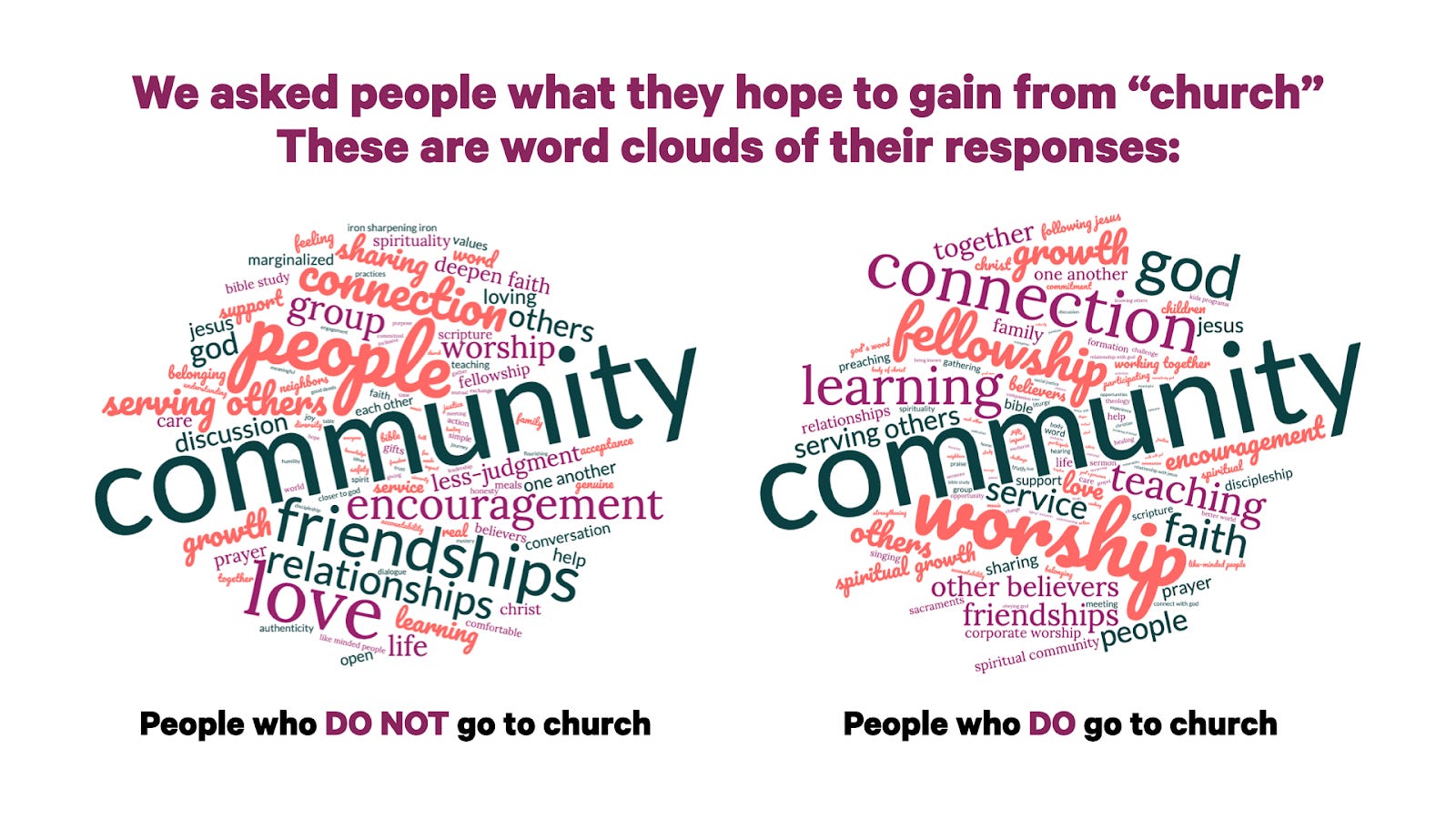
Both people who attended church regularly and those who did not had the same answer by a large margin: community! Undoubtedly, many churches would say they value relationships. Some would say community is central to their mission and strategy. But the real question is whether the design of our practices and structures actually reflect the things we value. How much of our time, energy, and resources are devoted to the attractional event on Sunday? In a worship gathering, what percentage of time do people spend facing forward vs. facing each other? How many staff and volunteer hours go toward program production versus facilitating genuine relational connection?
Rethinking Spiritual Formation in a Phygital World
I heard a pastoral colleague once say something that stuck with me: “Information is not transformation.” We have access to more Biblical and theological knowledge than at any other time in history. Yet, I am not convinced it has produced more humble, compassionate, and Christlike people. Good information matters, of course. But as the apostle Paul warned, “knowledge puffs up, love builds up.” (1 Cor 8:1) We need to shift from the western Church’s overemphasis on head knowledge toward holistic connection.
The most natural ways people experience healing, growth, and transformation are embodied practice and loving relationships—through face-to-face modeling and mirroring. Nobel prize winner Albert Schweitzer said, “Example is not the main thing when it comes to influencing others. It is the only thing.” We see this demonstrated throughout the ministry of Jesus as he invited his disciples to “come follow me.” Relationships have always been the original and most fundamental technology of human formation and change. From infancy through adulthood, we’re hardwired for connection.
If this is true, rethinking spiritual formation in a phygital world is about more than moving from physical pulpits to digital platforms. We have to go beyond content delivery and consider some deeper questions. How can we foster more meaningful connection and real conversation? How do we help people feel seen and known, and show up as their whole selves? How do we empower people to create the connections and community they need?
When I was in seminary, we never gave much attention to questions such as these! Most of my practical ministry training had to do with gaining and disseminating knowledge. Many of us may need to learn a whole new set of skills. We may need to shift from being the expert with all the answers to a facilitator with good questions. Or, from being the main attraction on stage to being a host who sets the table for others. What if leaders could practice decentering themselves to make room for the conversation that needs to happen in the room?
Here are a few practical ideas of what shifting from content to connection in a phygital world can look like:
Investing in online community platforms like Circle, Mighty Networks, or Discord. Instead of ministry staff being the hub for every interaction (which creates dependency), equip and empower people to find each other and self-organize their own connections and community.
Incorporating interactive elements in worship or community gatherings using live chats, Q&A’s and polling, and shared photo albums.
Using social media accounts to share stories from community members can help create culture and foster a sense of belonging.
Using surveys to match people for virtual coffee or in-person meet ups.
Whether you’re ministering to people in primarily digital or physical settings, the shift from content to connection is about a fundamental reorientation of what we believe “church” is for. The future of ministry is less about what we know and more about how deeply we belong to one another. Our challenge is to use every digital and physical tool available to us to reimagine not just what we talk about but how and who gets to be a part of the conversation. When we design for connection and relationships first, we will have no trouble finding content that is relevant, alive, and worth gathering for.
Having seen the early version of what you're building, I really believe it will remove a lot of the friction and pain points in online meaning. Hopefully that will open space (and hearts) to make the hard work of connecting online a little easier.