


Ask someone today, “What’s your spiritual background?”, and you’re more likely than ever to get a long and varied answer. “I grew up Presbyterian, was Pentecostal in college, then Southern Baptist, stepped away for a bit, then came back to a non-denominational church, and now I’m exploring Catholicism… and I do yoga.”
We don’t pay sufficient attention to the fact that the very possibility of accessing and engaging with numerous spiritual traditions is a relatively recent phenomenon and a monumental shift in the way we practice faith, with profound implications. This trend is unlikely to slow down. Faith is only becoming more diverse, eclectic, and hybridized. The future of spirituality is already here. The question is whether the Church’s methods and models are ready to adapt.
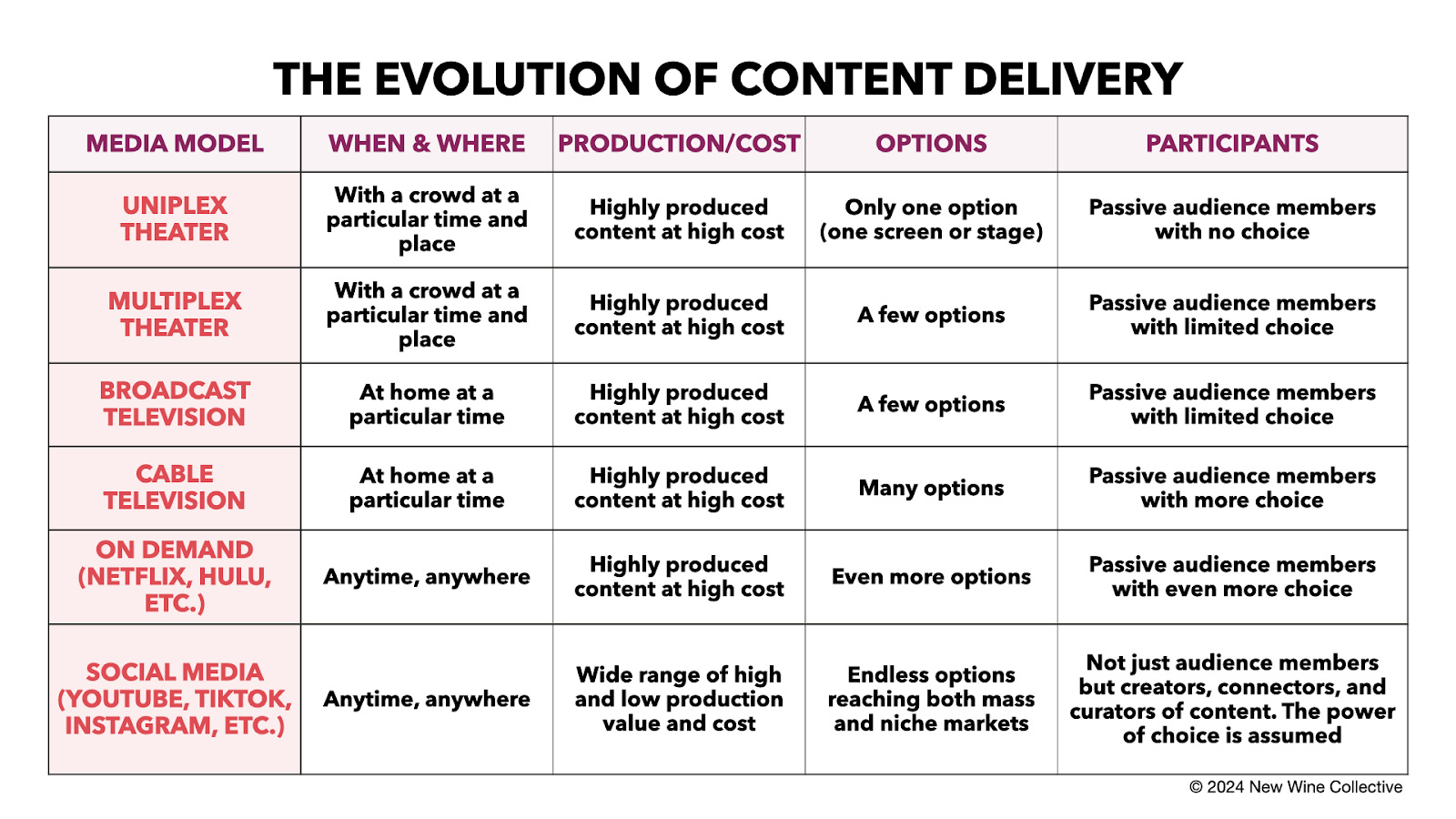
Of course, this shift has been largely driven by globalization, new technology, and the advent of the information age. One can trace this evolution over the last 80 years of visual media: from single-plex movie theaters, where passive audience members consumed content at a fixed time and place, to social media, where anyone can engage anytime, anywhere, across multiple devices.
Many people will still go to movie theaters, but it’s clear we’ve already moved far beyond passive consumption of just a few limited options to an ocean of diverse, on-demand, interactive content. Yet, in a world where people can access almost any voice, topic, style, culture, and spiritual background at the touch of a screen, most churches are still operating under a uniplex theater model. It’s no wonder many churches struggle to remain relevant in an increasingly diverse and fast-changing culture.
What does this mean for the Church?
When I was pastoring a church, I was well aware that I might not be the right pastor for everyone, and that what our church offered might not be what every person needs in every season of life. On any given Sunday, I knew the sermon would miss the needs and lived experiences of the majority of people in the room, because any congregation will have people who are showing up with grief, some who are happy, some who need encouragement, and others who need to be challenged.
There’s nothing wrong with services and sermons. We just need to think beyond the model of church as an event where people mostly sit and listen, or have no input or agency regarding what gets addressed and how.
More and more people are experiencing faith and spirituality as a journey, not a static destination. Spiritual growth is not a linear process, and each person’s journey is unique, coming from different backgrounds and cultures, with different needs and ways of connecting with God. Sunday morning service simply does not work for everyone anymore. In truth, it never did.
Therefore, churches can no longer see themselves as one-stop shops for spiritual growth. We need to move beyond one-size-fits-all programming and instead empower people to discern what they need to take the next step in their journey. Rising generations, in particular, already assume agency and choice in matters of faith. Churches must adapt to this new reality and redefine their role in the changing spiritual landscape.
The shift from “limits to liberation” does not mean abandoning programs and structure. It means reimagining what our programs and structures are for. Fewer and fewer people will limit themselves to a single source, such as a single theater, restaurant, or even Christian tradition. What people need today may be more like a diverse food hall or a farmer’s market, with many options to choose from, each one good in its own way. Churches that thrive in this new landscape will see themselves as less isolated and more as part of an open ecosystem. And healthy ecosystems require biodiversity—many different species of plants and animals playing different roles, but all contributing to the whole.
Imagine if people could access not just a few but a multitude of diverse voices, traditions, and experiences in community with others. Imagine if the Church could function more like one body, made up of many parts. New technology can do far more than add a few tools to our existing toolkit. With imagination and intention, it can fundamentally reshape our ecclesiology—the way we understand the Church itself.
What might this actually look like? A few experiments worth considering:
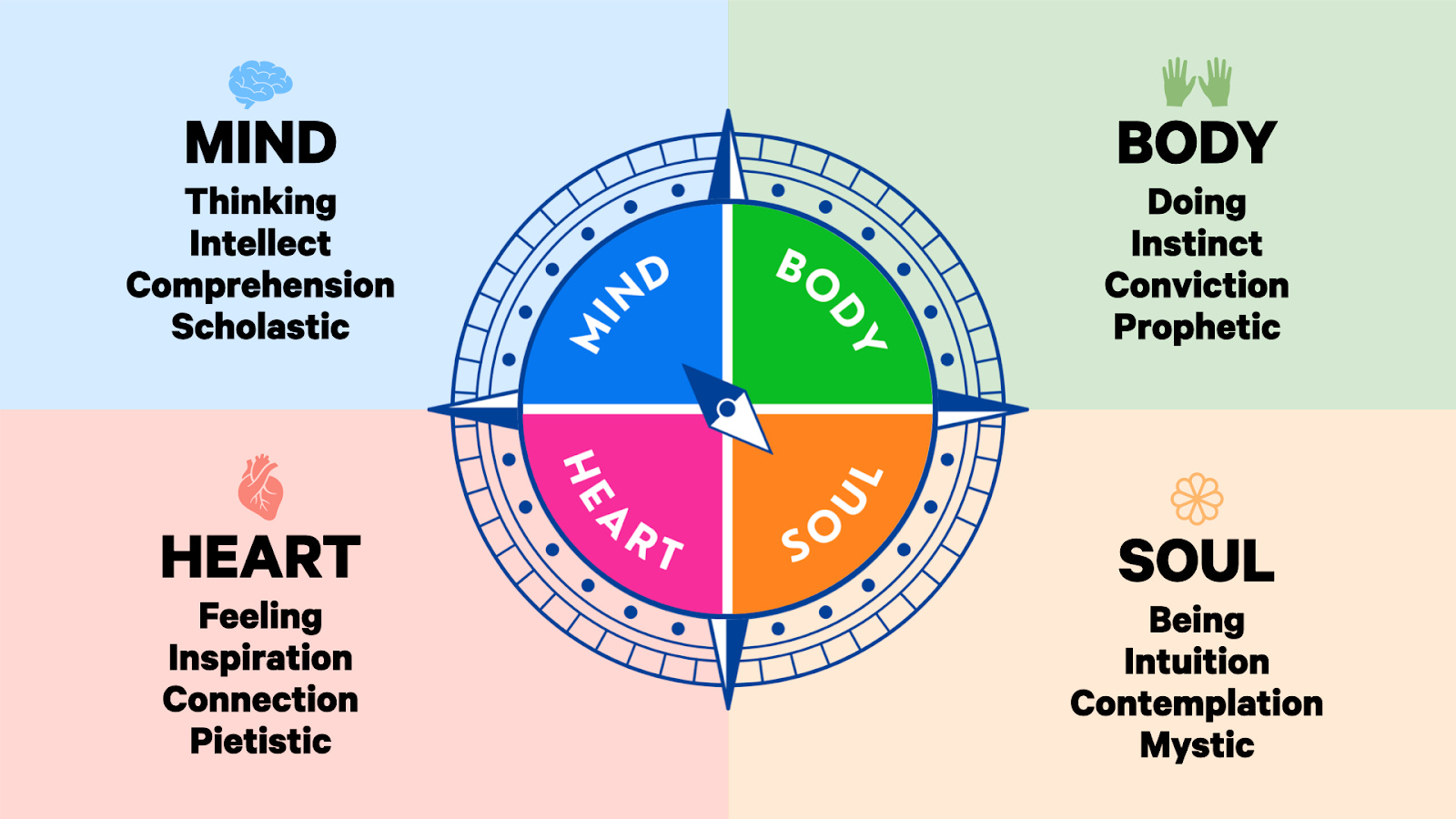
Curate many pathways, not just limited programs. Rather than asking “How do we get people into our programs?”, start asking “How do we help people discern what they need next?” This might mean explicitly naming the different ways people in your community connect with God — contemplative practices, theological exploration, embodied worship, service and justice, creative expression — and pointing to resources, even if they exist outside your regular programming or what happens on Sunday morning.
In my work with New Wine Collective, we developed a navigation tool for the spiritual journey to help people discern where they might need to go next. Instead of prescribing linear programs, our goal is to build an online library of crowdsourced resources that anyone could both access (download) and contribute to (upload). A church could maintain a similar database of resources, both crowdsourced by congregants and curated by ministry staff.
Shift from producing content to cultivating participation. The social media revolution didn’t just multiply options; it redefined who gets to be a creator. The most transformative thing many churches could do is to take seriously the priesthood of all believers, not as a theological talking point but as an organizing principle. Who in your community is already a creator, connector, or curator of spiritual wisdom? Are you making room for them, or are they sitting in the pew consuming your content?
At a Christian college, I helped design a spiritual formation week that empowered student teams to lead diverse spiritual practices and experiences across campus at different times throughout the week. We decentralized the chapel program (one program, place, and time) into dozens of smaller gatherings exploring a wide range of spiritual traditions. It was a huge success with many students reporting that they discovered God in ways they’d never experienced before. This was facilitated by a website, online sign-up forms, and spreadsheets to keep everything organized, as well as in-person gatherings for alignment and vision. Could something similar happen in a local church context?
Design for the “phygital” pilgrim. An increasing number of people are engaging with spiritual community in hybrid or primarily digital ways, sometimes online, sometimes in person, and sometimes through a podcast, blog, or Discord server. Rather than treating these as lesser forms of belonging, map the actual ways people are participating and design intentionally for the full spectrum of people’s experiences. We have more tools than ever to bring spiritual connection and community into people’s everyday lives. How to implement them depends heavily on context and demographics. A good strategy is usually to find where people already gather online and then invite a few trusted people to intentionally cultivate community there.
We can only be liberated together.
The goal is not for any one church or ministry to do everything for everyone. It’s to begin seeing ourselves as parts of a greater whole: a diverse, interconnected body where each expression of faith contributes something the others cannot. People don’t need us to have all the answers. They need us to be willing to reimagine together what the Church can become. This requires a shift in mindset that decenters our own programming and opens up to a more expansive view of the Church that honors the unique journey each person is on.
If you’re already engaged in digital ministry in some form, you are a much-needed resource in the shifting spiritual landscape. If you’re leading in a more traditional, local church setting, your role in the spiritual ecosystem is still vitally important, and there are ministries that can help you meet your people where they are. How can we all work together to better serve the people we feel called to serve?
What you're building is truly a powerful tool. I hope that you're able to crack the content-to-participation shift. I think that's the key to going from informing to transforming.
Thanks for sharing this. It’s a good one. As I prepare for ordination and express my desire to exercise gifts in digital ministries, I keep getting the challenge, “But what about community?” as if there is no community in digital spaces.
A favorite line here: “People don’t need us to have all the answers. They need us to be willing to reimagine together what the Church can become. This requires a shift in mindset that decenters our own programming and opens up to a more expansive view of the Church that honors the unique journey each person is on.”