


What is infrastructure?
Infrastructure is the set of systems, including utilities, transportation, and financial networks, that connect people and enable resources and information to flow. These systems operate mostly in the background, and we tend not to think about them until one of them fails.
We turn on the faucet and expect clean water. We flip a switch and expect light. We use a credit card and expect our payment to go through. But when the power grid goes out, a bridge closes, or when a water main bursts, we suddenly notice how much of our lives depend on the infrastructure we seldom pay attention to. The same can be true of our spiritual lives.
What We Mean By Spiritual Infrastructure
The life of faith has infrastructure too. Spiritual infrastructure is the set of systems that support spiritual life and community. Denominations, seminaries, publishing networks, credentialing processes, camps and retreat centers, and even church buildings all play this role. They form leaders, move money, share ideas, gather people, and hold communities together across distance and time.
For generations, this infrastructure worked well enough that most of us have simply taken it for granted. But that may not be the case for much longer. Church affiliation and funding are in decline. Seminaries are closing or merging. Many denominations and institutions are struggling to adapt to a fast-changing world. Like a power grid built for a different century, much of the Church’s infrastructure was designed for a world that no longer exists. We are noticing it now because it is showing signs of failure.
Sue Phillips builds this case more thoroughly in her article, “The Spiritual Infrastructure of the Future.”
Living In A Phygital World
The word phygital is a portmanteau of physical and digital. It names what most of us are already living: there is no longer a clear separation between online and offline life. Digital technology and the internet have reshaped how we work, learn, organize, find community, and even form our sense of self. During the COVID-19 pandemic, many congregations discovered almost overnight that ministry could happen through screens as well as in sanctuaries. Most of our lives now are an inescapable amalgamation of the physical and digital, which has already had profound implications, and the Church still seems to be catching up.
Technology and the internet have disrupted nearly every industry, making possible things we could not have imagined 30 years ago. Oceans of information, content, and even connection with others are available at the touch of a screen anytime, anywhere. Yet phygital ministry is not just about replacing physical community with digital tools, nor does it mean merely adding a livestream to Sunday services as usual. It recognizes that people’s lives now move fluidly between embodied and digital spaces, and that ministry must meet them in both.
The question is: How can we design and build the spiritual infrastructure we need in light of this new reality?
One way to answer is to turn to the image of an iceberg.
Diving Below The Surface
Systems thinkers often use the familiar iceberg metaphor to understand complex problems. Most of an iceberg’s mass sits below the waterline. In a system, likewise, the presenting problem visible above the water is only a small part of what is actually happening. Seeing the rest requires a deeper dive below the surface. The iceberg can also help us understand the deeper work required to design and build the spiritual infrastructure needed for a changing world.
The classic iceberg model divides a system into four tiers. At the surface are events: the observable, one-off occurrences we can point to, such as a pastor burning out. Just beneath the waterline are patterns: recurring trends that reveal a single event isn’t an anomaly but part of something larger (e.g., many pastors reporting emotional exhaustion). Below those are structures: who holds power, who makes decisions, what incentives are at play, and what channels resources flow through. At the very bottom lie our mental models, or paradigms: the underlying beliefs and assumptions so deeply embedded that we seldom question them.
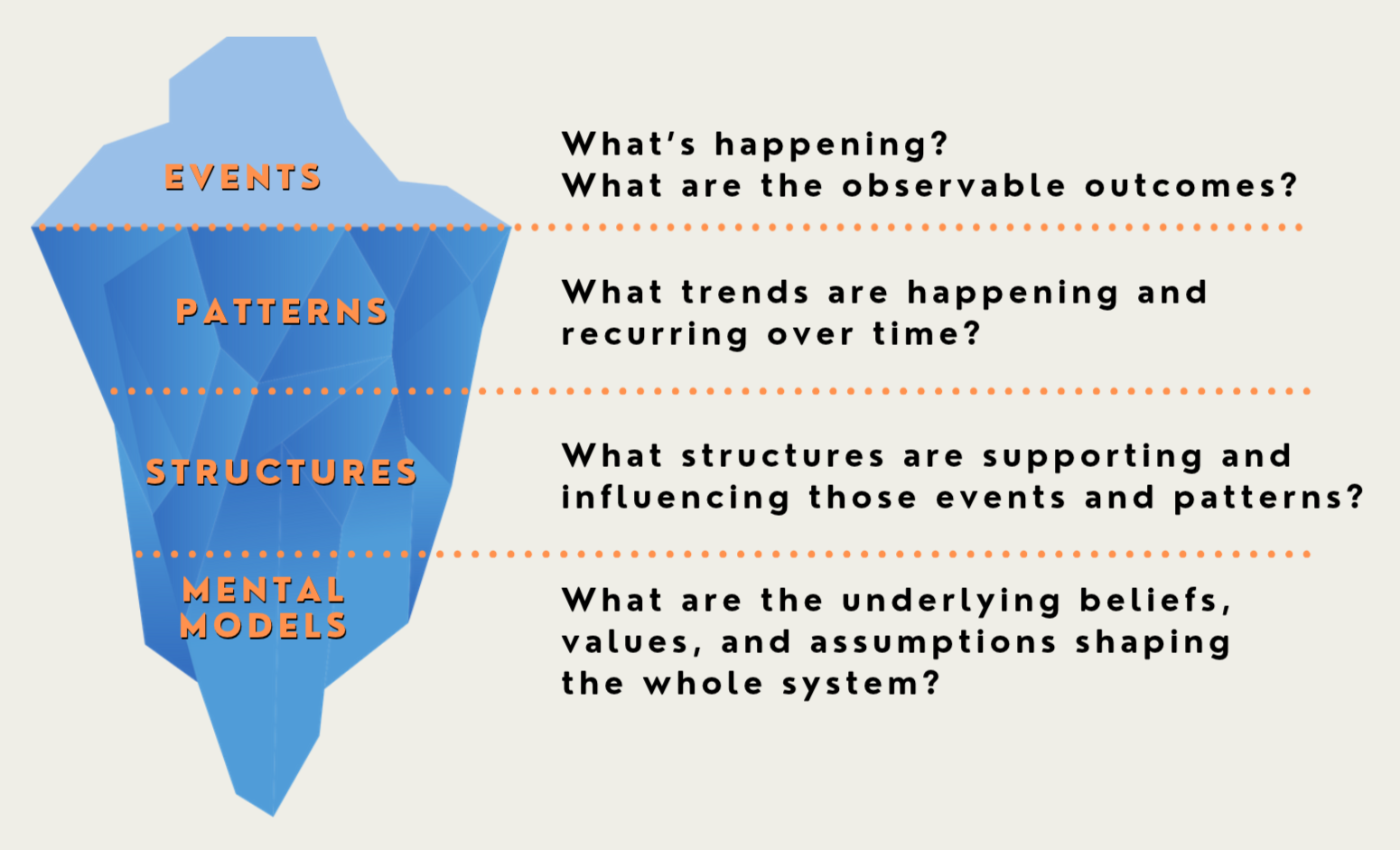
Many change efforts stay at the surface or just below the waterline, focusing on individual events and patterns. We give the burnt-out pastor a sabbatical, or open a counseling center for ministry leaders. Short-term solutions can be necessary, yet they often treat the symptoms while ignoring the root cause. Donella Meadows, the pioneering environmental scientist and systems thinker, argued that the greatest leverage for meaningful change lies in the deeper layers: our underlying structures and the assumptions that drive them.
This is the deep work needed today: to go beyond quick fixes and surface-level solutions, and critically examine the mental models we have inherited. Then reimagine the Church’s structures not from the top down, but from the bottom of the iceberg up.
Put simply, infrastructure work is systems work. It requires seeing the whole picture and the connections between all its parts, especially in light of our new cultural and phygital realities.
Structure Is Belief Made Visible
In the iceberg model, structure relates to the channels through which people connect, make decisions, and move resources and information. But structures do not appear out of nowhere.
Every structure is a mental model made concrete. A church building assumes that ministry happens mainly in one place, at set times. Most seminaries assume ministry is primarily a knowledge-based profession requiring credentials granted by an institution. Institutional hierarchies assume that power, authority, and resources are to be consolidated at the center before being distributed outward. These assumptions made sense for a certain time, and they have produced much good. But the world is changing, and these assumptions are being challenged like never before.
This is why infrastructure work must examine the paradigms beneath it. Otherwise, we may simply reproduce the old system in new packaging. Streaming a Sunday service can be a valuable addition to a church’s programming. At the same time, it places a physical-era paradigm onto a digital tool: one leader on a stage or screen, an audience watching, and a single weekly gathering at the center of community life. The delivery method is new, but the underlying assumptions are not.
New infrastructure for the Church will need more than upgrading the old system with digital tools. It will come from asking deeper questions at every level of the iceberg: What is the Church, and what is it for? Then we must design accordingly with all the wisdom, tools, and resources at our disposal.
A Critical Moment
The time to do this work is not when our systems collapse, but while the warning signs are still only warnings. The opportunity is now, while the Church still has the resources to compost toward nourishing new experiments.
In a way, building new infrastructure is always an act of faith. It’s investing in a future we cannot yet fully see. But as the saying goes, we plant trees whose shade we may never sit in. And the season for planting is now.
Questions To Consider:
Events and Patterns
What signs of infrastructure breakdown or obsolescence are you seeing in your own context? Which feel like isolated events, and which are part of a larger pattern?
Structures
Where do resources, information, and decision-making flow in your community or network right now? Who is left out of those flows?
Which parts of today’s spiritual infrastructure are still life-giving and worth carrying forward? Which need to be composted?
Mental Models
What assumptions about church, ministry, leadership, and community are built into the structures we have inherited? Which come from the way of Jesus, and which come from a particular time and culture?
What would change if we treated digital spaces not as a broadcast channel for physical gatherings, but as places where real community and formation happen?
Redesigning For A Phygital World
What is already emerging at the margins, in small communities, networks, and experiments, that might point toward the infrastructure of the future?
If we were designing spiritual infrastructure from scratch for a phygital world, what would it need to connect, and what would need to flow through it?
For more insights check out:
Sue Phillips, “The Spiritual Infrastructure of the Future” (Harvard Divinity Bulletin)
https://bulletin.hds.harvard.edu/the-spiritual-infrastructure-of-the-future/
Phillips argues that denominations work like utilities for religious life, built on assumptions that no longer match how people look for meaning. She calls on religious leaders to redesign those systems to support spiritual innovators, not resist them.
Dee Hock, “The Nature and Creation of Chaordic Organizations” (The Systems Thinker)
https://thesystemsthinker.com/the-nature-and-creation-of-chaordic-organizations/
Hock, the founder of Visa, argues that rigid, top-down institutions from the industrial era are failing at the very goals they were built for. In their place he proposes “chaordic” organizations that people join by choice and that hold together around a shared purpose and principles.
David Ehrlichman, “Fostering Self-Organization” (Stanford Social Innovation Review)
https://ssir.org/books/excerpts/entry/fostering_self_organization
In this excerpt from Impact Networks, Ehrlichman says self-organizing networks still need leaders. Their job is to share leadership, encourage connection and experimentation, and build resilience through relationships.